Small objects often contain details that are difficult to see with the naked eye. A coin may have tiny lettering around its edge, a collectible stamp can show subtle printing differences, and an electronic circuit board may contain components that are almost impossible to inspect comfortably without magnification. For collectors, hobbyists, students, and people who work with small objects, a digital microscope can make these details easier to examine.
Unlike a traditional optical magnifier, a digital microscope uses a camera sensor to capture an enlarged image and presents it on a screen. This changes the way users interact with the object. Rather than holding a small lens close to the eye, they can look at a display while adjusting the object, lighting, and magnification to suit the task.
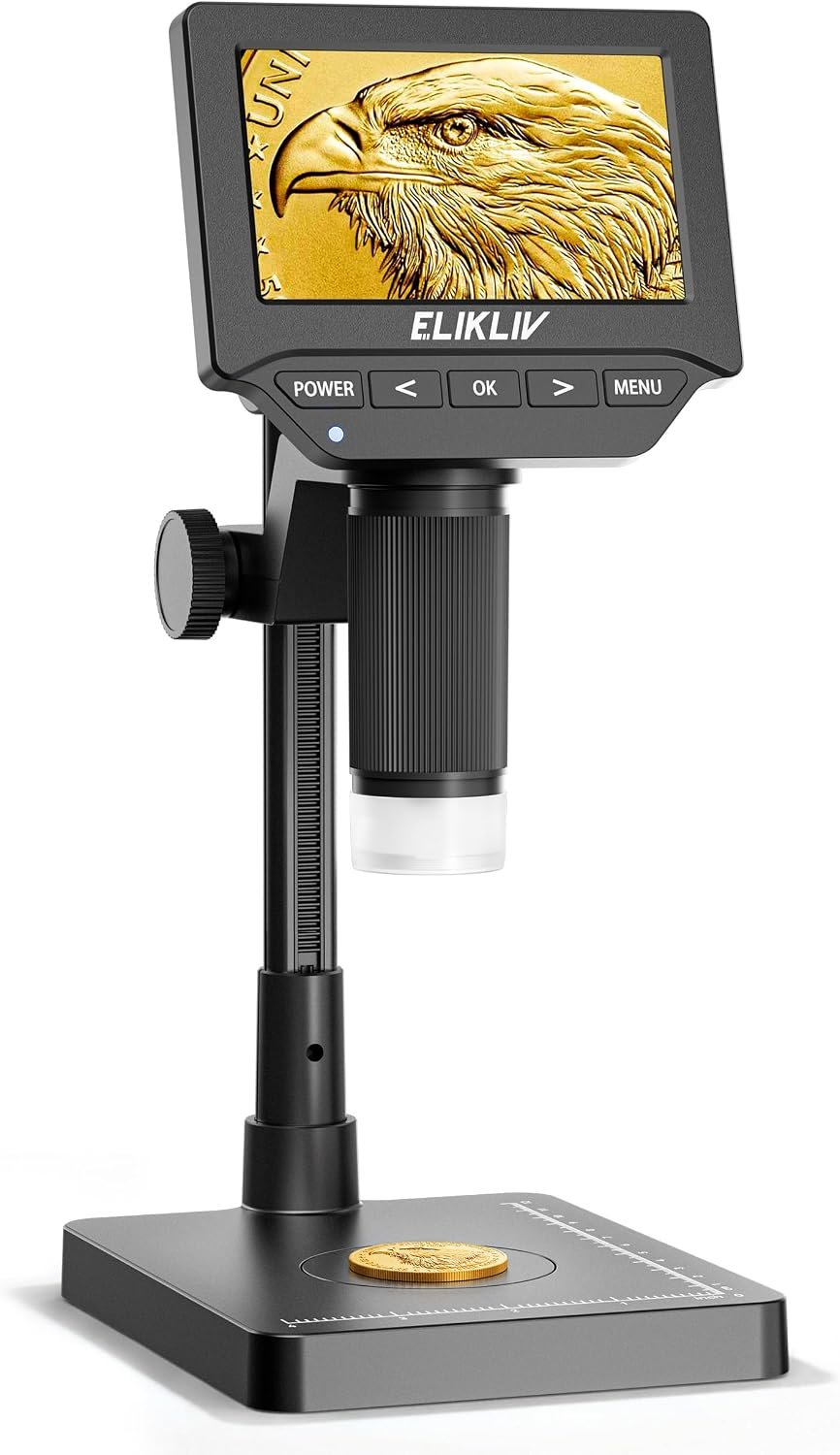
The Elikliv Microscope, described as a 4.3-inch digital coin magnifier with lights for adults, is designed around this approach. Its screen-based format is intended to help users inspect coins and other small objects while providing illumination for close-up viewing. This type of device can also be relevant to people interested in stamps, jewelry, electronic components, small mechanical parts, and educational observation.
The usefulness of a digital microscope depends on more than magnification alone. Lighting, focus, working distance, image clarity, stability, screen size, and the characteristics of the object being examined all affect the final result.
This guide explains how the Elikliv digital microscope fits into the broader category of compact inspection tools, how it may be used for coin collecting and other hobbies, what to consider before using one, and how digital microscopes compare with traditional magnifiers and more advanced optical equipment.
What Is a Digital Microscope?
A digital microscope is an optical inspection device that uses a camera sensor and digital display to show enlarged views of small objects.
A conventional magnifying glass relies on a lens to enlarge the image viewed directly through it. A digital microscope instead captures the image electronically and displays it on a screen. Depending on the device, the image may also be available for photography, recording, or transfer to another device.
This screen-based arrangement can make extended inspection more comfortable for some users because they do not have to position their eye directly behind a small eyepiece.
Digital microscopes are available in many forms, ranging from compact handheld units to larger laboratory instruments with adjustable stands, external monitors, and specialized lighting systems.
A compact model with a 4.3-inch screen is oriented toward personal inspection and everyday hobbies rather than necessarily replacing a professional laboratory microscope.
For coin collectors, the main appeal is the ability to examine small features such as mint marks, lettering, surface texture, fine scratches, and manufacturing details.
The same basic principle can be applied to many other small objects, provided that the device’s optical capabilities and working distance are suitable for the task.
Understanding the 4.3-Inch Display
The 4.3-inch screen is one of the defining characteristics of this type of digital microscope.
Instead of looking through a traditional eyepiece, the user views the enlarged image on a built-in display. The screen acts as the viewing interface, allowing the user to inspect an object while keeping both eyes open.
This arrangement can be particularly convenient for hobbies that involve repeatedly moving an object under the camera.
For example, someone examining a coin can rotate it slowly while watching the screen for changes in lettering, surface marks, or other features.
A built-in screen also means the user does not necessarily need to connect the microscope to a computer just to begin viewing objects. However, additional connectivity and image-transfer capabilities should be verified in the current product documentation rather than assumed.
Why Screen Size Matters
A screen provides a practical balance between portability and visibility.
A very small display may make it harder to inspect details comfortably, while a larger monitor can require more desk space and additional equipment.
A 4.3-inch display offers a compact viewing area that can be convenient for tabletop inspection.
However, screen size alone does not determine image quality. Resolution, camera performance, focus, lighting, and the quality of the optical system also matter.
A larger screen cannot restore detail that the camera sensor or optics did not capture in the first place.
Key Features of the Elikliv Digital Coin Microscope
Digital Magnification
The main purpose of a digital microscope is to make small details easier to inspect.
Magnification can help reveal features that may be difficult to distinguish with an unaided eye, especially when the object contains fine surface markings.
For coin collecting, this may include examining lettering, date numerals, mint marks, scratches, small design elements, and signs of wear.
The actual detail visible depends on the device’s optical system, sensor, lighting, focus, and the physical condition of the coin.
It is important to distinguish between enlarging an image and resolving additional detail. A highly enlarged image may appear larger without necessarily revealing more useful information.
For this reason, magnification claims should be interpreted alongside the microscope’s image quality and practical viewing capabilities.
Built-In Lighting
Lighting plays an important role in close-up inspection.
Small objects can contain shadows, reflective surfaces, and fine textures that are difficult to examine under ordinary room lighting. A microscope with integrated lights can provide a more controlled source of illumination.
For coins, light can help reveal raised design elements, surface wear, and small scratches. For electronic components, suitable illumination can make solder joints and component markings easier to inspect.
The best lighting arrangement depends on the object.
A reflective coin may produce glare when the light hits its surface directly. In such cases, adjusting the angle of the object or the illumination can sometimes reveal more detail.
Built-in lighting is convenient because it keeps the illumination close to the viewing area, but it does not eliminate the need to adjust the position of the object.
Coin Inspection
Coin collecting is one of the most natural applications for a digital magnifier.
Collectors may want to examine a coin’s date, lettering, mint mark, edge characteristics, surface condition, or visible damage.
A digital microscope can help make these features easier to observe.
It can also be useful when comparing two coins side by side, particularly when the user wants to identify differences in wear or surface appearance.
However, a close-up image should not be treated as a complete assessment of a coin’s authenticity or value. Authentication can require specialized knowledge, measurements, reference materials, and sometimes professional examination.
Screen-Based Viewing
Viewing an enlarged image on a built-in display can make it easier to move objects while maintaining a consistent viewing position.
The user can place a coin under the camera, watch the display, and adjust the object’s position to inspect different areas.
This may be more convenient than repeatedly repositioning a handheld magnifying glass.
A screen-based system can also be useful for people who prefer not to look through a traditional microscope eyepiece for long periods.
Compact Inspection Format
Compact digital microscopes are intended to provide magnification without requiring the space associated with a large laboratory instrument.
A smaller inspection setup can be practical on a desk, hobby table, workshop bench, or study surface.
It may be useful for people who inspect objects occasionally and want a dedicated tool that can be stored when not in use.
The actual footprint, stand design, adjustment range, and storage requirements should be checked in the product listing or manual.
How the Elikliv Microscope Can Be Used
Examining Coins
Coin inspection is a common use for digital magnification.
Collectors may examine the front and back of a coin to identify design details, compare lettering, or observe signs of wear.
A digital microscope can help bring these features into view, especially when the object is positioned at a stable distance from the camera.
For a basic inspection, place the coin on a clean, stable surface beneath the viewing area. Adjust the focus and lighting, then move the coin gradually to examine different sections.
Avoid rubbing the coin against the work surface. Collectible coins can be damaged by unnecessary handling, and cleaning can reduce their value or alter their original surface.
If the coin is potentially valuable, use appropriate handling practices and consult reliable numismatic references before attempting any cleaning or restoration.
Identifying Mint Marks and Date Details
Some coins contain small mint marks or date features that can be difficult to distinguish under ordinary lighting.
A digital microscope can make these areas easier to view.
The user can examine the relevant part of the design, adjust the lighting, and compare the visible characteristics with trusted references.
This can be helpful when learning about coin varieties or organizing a collection.
However, small differences should not automatically be interpreted as proof that a coin is rare or valuable. Identifying a variety often requires careful comparison with authoritative numismatic information.
Inspecting Surface Wear
Surface condition is an important consideration in coin collecting.
A microscope can help users observe scratches, marks, corrosion, and areas of wear that may not be immediately visible.
It can also reveal details that are easily mistaken for manufacturing features.
For example, a small mark might be a contact mark, a scratch, or part of the original design. Magnification can help the user inspect the feature, but interpretation still requires knowledge of the coin’s manufacturing process and history.
Stamp and Collectible Inspection
Digital magnification can also be useful for stamps, trading cards, miniature collectibles, and other objects containing fine printed or engraved details.
For stamps, users may examine printing patterns, perforations, small lettering, and surface condition.
For other collectibles, magnification may reveal small defects, production marks, or texture differences.
The microscope should be used carefully around delicate paper items. Excessive pressure, moisture, or unnecessary handling can damage fragile collectibles.
Jewelry and Small Decorative Items
Jewelry often contains fine details such as settings, engravings, surface scratches, and small decorative elements.
A digital microscope can help users inspect these features more closely.
For example, someone may want to examine the condition of a ring setting or look for visible damage on a small decorative object.
However, a digital microscope is not automatically a gem-testing or precious-metal identification instrument. Magnification alone cannot reliably establish the composition, authenticity, or monetary value of a gemstone or metal.
Specialized testing methods may be necessary for those purposes.
Electronic Component Inspection
Small electronics can contain components, printed markings, solder joints, and circuit traces that are difficult to inspect without magnification.
A digital microscope may help hobbyists or repair technicians examine these areas visually.
It can be useful for checking whether a connector appears damaged, whether a solder joint has visible irregularities, or whether a component marking can be read.
Visual inspection is only one part of electronics troubleshooting. A microscope cannot independently determine whether a circuit is electrically functional.
Users should also observe electrical safety precautions and disconnect power before inspecting or working on electronic equipment when appropriate.
Small Mechanical Parts
Hobbyists who work with miniature mechanisms may use magnification to examine gears, springs, fasteners, threads, and other small components.
This can be useful for identifying visible wear or understanding how parts fit together.
The device may also help with general workshop observation, although its suitability depends on the size of the object and the microscope’s available working distance.
Larger objects may not fit comfortably under a compact microscope.
Educational Observation
Digital microscopes can make small details more accessible for learning activities.
Students and hobbyists may use magnification to examine paper fibers, plant surfaces, fabric, small manufactured objects, and other non-hazardous samples.
A screen-based display can make the observation process easier to follow because the enlarged image is visible without requiring a traditional microscope eyepiece.
The device can support questions about texture, structure, and surface patterns, although the quality of the observations depends on the microscope’s actual optical capabilities.
Users should avoid examining hazardous biological materials or substances unless the activity is appropriate for the equipment and follows relevant safety procedures.
Who May Find This Digital Microscope Useful?
Coin Collectors
Collectors may appreciate the ability to inspect small design features, lettering, mint marks, and visible surface conditions.
The device can support routine examination and comparison, particularly for people who want a dedicated screen-based tool for a coin collection.
Hobbyists and Collectible Enthusiasts
People who collect stamps, miniatures, small antiques, or other detailed objects may find digital magnification useful for everyday inspection.
The most suitable application depends on the size and surface characteristics of the objects being examined.
Electronics Hobbyists
People who repair small devices or build electronic projects may use magnification to inspect components and solder joints.
A compact digital microscope can provide another perspective when visual detail is difficult to see without assistance.
Students and Educators
A digital microscope can support demonstrations and observational learning.
It may be useful in activities that involve comparing textures, examining small structures, or learning how magnification changes the visibility of an object.
Its suitability for formal scientific work depends on the required magnification, resolution, measurement capabilities, and other specifications.
Crafters and Model Makers
Model makers, miniature painters, and craft enthusiasts sometimes work with small decorative details.
Magnification can help them inspect fine lines, surface imperfections, and small parts while planning or completing a project.
People Who Prefer Screen-Based Viewing
Some users find a built-in display more convenient than looking through a traditional optical eyepiece.
A digital screen allows the user to maintain a normal viewing posture while observing an enlarged image.
However, comfort still depends on the screen’s position, viewing angle, lighting, and the duration of use.
Important Things to Consider Before Using a Digital Microscope
Magnification Is Not the Same as Resolution
One of the most important concepts in digital microscopy is the difference between magnification and resolution.
Magnification describes how large an image appears. Resolution describes the ability to distinguish nearby details as separate features.
A device can enlarge an image significantly without providing enough detail to distinguish extremely small structures.
When evaluating a digital microscope, look for information about the camera sensor, display resolution, optical design, and real-world image quality rather than relying exclusively on a magnification number.
Focus and Working Distance
The working distance is the space between the microscope’s lens and the object being examined.
A short working distance can be suitable for small objects but may make it harder to position taller items beneath the camera.
Focus also affects the amount of detail visible.
If the object is too close or too far from the lens, the image may appear blurred. A stable surface and careful adjustment can help maintain a clear view.
Lighting and Glare
Coins, jewelry, and other reflective objects can produce bright reflections under direct illumination.
These reflections may hide the very details the user wants to examine.
Try adjusting the object or changing the lighting angle rather than assuming that maximum brightness will always provide the clearest image.
Matte objects and reflective objects may require different approaches.
Stability
Small movements can affect the appearance of a magnified image.
A stable work surface helps reduce unwanted movement while inspecting fine details.
When comparing two objects, try to keep the viewing position and lighting as consistent as possible. This makes visual differences easier to interpret.
Image Storage and Connectivity
Some digital microscopes provide image capture, recording, computer connectivity, or file-transfer functions, while others have more limited capabilities.
Do not assume that the Elikliv model supports a particular connection or file format unless the current product documentation confirms it.
If saving images is important, check whether the device supports the required storage method, transfer process, and image resolution.
Power Requirements
Digital microscopes require power for their electronic components and display.
The exact power source and operating method depend on the design.
Check the product listing or manual for details about charging, batteries, cables, or external power requirements before planning to use the microscope away from a desk.
Portability and Workspace
A compact microscope may be easier to store than a larger optical instrument, but it still needs an appropriate working surface.
Users should consider where they will place the device and whether the stand provides enough space for the objects they intend to inspect.
For coin collecting, a clean table with room for reference materials can make the process easier.
For electronics work, the microscope should fit comfortably within the existing workbench arrangement.
Limits of Authentication
A digital microscope can reveal visual details, but it should not be treated as an automatic authentication system.
Coin authentication, jewelry assessment, and the identification of specialized materials may require measurements, reference comparisons, professional expertise, or additional testing.
An enlarged image can support an assessment, but it does not independently establish authenticity or value.
Digital Microscope vs. Traditional Magnifying Glass
A traditional magnifying glass is simple, portable, and usually requires no power.
It can be useful for quick inspections, reading small print, or examining objects while moving around.
A digital microscope offers a different experience because it displays an enlarged image on a screen.
This can be helpful for longer inspection sessions or when the user wants to view details without positioning an eye directly behind a lens.
However, a magnifying glass can be easier to carry and use for quick checks. It may also provide a more immediate view without requiring electronic components.
The right tool depends on the level of detail needed and the user’s preferred way of viewing small objects.
Digital Microscope vs. Optical Microscope
An optical microscope uses lenses to magnify an image that the user views directly through an eyepiece or optical system.
Laboratory optical microscopes can support demanding scientific applications when equipped with appropriate objectives, lighting, and other components.
A digital microscope uses a camera sensor and display to present the image electronically.
This makes screen-based viewing convenient, but the device’s actual capabilities depend on its optics, sensor, processing, and display.
A compact digital coin microscope is generally intended for close-up inspection and hobby use rather than automatically replacing laboratory-grade equipment.
Users who need precise measurements, advanced specimen analysis, or specific scientific capabilities should check the specifications required for their work.
Digital Microscope vs. USB Microscope
A USB microscope typically connects to a computer or another compatible host device to display the magnified image.
This arrangement can be useful for users who want to work with a larger monitor or save images directly to a computer.
A digital microscope with a built-in screen can provide a more self-contained viewing arrangement.
The trade-off is that a computer-connected model depends on compatible hardware and software, while a standalone screen-based model depends on its own display and supported features.
The appropriate choice depends on whether portability, direct computer integration, or a self-contained viewing setup is the priority.
Tips for Examining Coins With a Digital Microscope
Start With a Clean Work Surface
A clean surface reduces the risk of introducing dust or debris while moving coins beneath the camera.
It also makes it easier to keep the collection organized.
Handle Collectible Coins Carefully
Avoid touching delicate coin surfaces unnecessarily.
For potentially valuable pieces, follow established numismatic handling guidance. Cleaning or polishing a coin can damage its original surface and may reduce its collectible value.
Examine the Coin in Sections
Instead of trying to interpret the entire coin at once, inspect different areas systematically.
Look at the date, lettering, central design, edges, and any relevant mint marks.
This can make comparisons more organized.
Adjust Lighting Before Increasing Magnification
If a feature is difficult to see, the problem may be glare or shadow rather than insufficient enlargement.
Try changing the lighting or angle before assuming that a higher magnification setting will solve the issue.
Compare With Reliable References
If a feature appears unusual, compare it with trustworthy numismatic references or consult a knowledgeable professional.
A microscope can help reveal details, but interpreting those details accurately requires context.
Caring for the Digital Microscope
A digital microscope contains optical and electronic components that should be handled with care.
Follow the manufacturer’s instructions for cleaning the lens, screen, and exterior surfaces. Avoid abrasive materials or cleaning chemicals that have not been approved for the device.
When the microscope is not in use, store it in a clean, dry place where it is protected from impact, dust, and excessive moisture.
Avoid placing heavy objects on the display or forcing adjustment mechanisms.
If the device includes cables, charging components, or removable accessories, organize them so that they are not bent or strained unnecessarily.
Regular care can help keep the device ready for future inspection tasks.
Frequently Asked Questions
What is the Elikliv digital microscope designed for?
It is described as a digital microscope with a 4.3-inch screen, lighting, and a focus on coin magnification. It may also be useful for inspecting other small objects, depending on its optical capabilities and working distance.
Can it be used to inspect coins?
Coin inspection is one of the main applications of a digital coin microscope. Magnification can help users examine lettering, mint marks, surface wear, scratches, and other visible details.
Does a 4.3-inch screen determine image quality?
No. Screen size affects the viewing area, but image quality also depends on the camera sensor, optics, focus, lighting, processing, and display resolution.
Does greater magnification always reveal more detail?
No. Magnification makes an image appear larger, while resolution determines how clearly nearby features can be distinguished. Excessive digital enlargement may make an image larger without revealing additional useful information.
Can the microscope identify rare coins automatically?
A microscope can help users inspect visible characteristics, but magnification alone does not establish rarity, authenticity, or monetary value. Reliable identification may require reference materials and specialized knowledge.
Can it be used for electronics?
Digital microscopes can be useful for visually inspecting small electronic components, circuit traces, and solder joints. They do not independently establish whether a circuit is functioning correctly.
Is it suitable for jewelry inspection?
It may help users observe small details such as settings, engravings, and visible surface damage. However, it should not be treated as a complete gemstone or precious-metal authentication instrument.
Can a digital microscope replace a laboratory microscope?
Not necessarily. A compact digital microscope may be appropriate for hobby inspection, but laboratory work can require specific optical, measurement, and specimen-handling capabilities that a compact device may not provide.
Does the microscope need a computer?
That depends on the model’s design and supported features. A built-in screen allows direct viewing, but any additional computer connectivity should be confirmed in the product documentation.
Can images be saved?
Image capture and storage capabilities vary between digital microscopes. Check the current listing or manual to confirm whether the specific Elikliv model supports saving photographs, recording video, or transferring files.
Why do reflective coins sometimes look difficult to inspect?
Reflective surfaces can produce glare that obscures fine details. Adjusting the coin’s angle or the illumination may help reveal the surface more clearly.
Is a digital microscope useful for beginners?
It can be useful for beginners interested in coin collecting, small-object inspection, crafts, or basic electronics observation. The most important factors are understanding the device’s limits and learning how to adjust focus and lighting.
How should the lens be cleaned?
Follow the manufacturer’s cleaning instructions and use suitable materials. Avoid abrasive cloths or unapproved chemicals that could damage the optical surface.
Conclusion
The Elikliv Microscope, described as a 4.3-inch digital coin magnifier with lights for adults, belongs to a category of compact inspection tools designed to make small details easier to observe on a screen.
Its digital viewing approach can be useful for coin collectors, hobbyists, electronics enthusiasts, students, and people who regularly inspect small objects. Integrated lighting can support close-up observation, while the screen-based format provides an alternative to viewing through a traditional magnifying glass or microscope eyepiece.
The most useful results depend on how the device is applied. Focus, lighting, working distance, stability, object condition, and image resolution all influence the details that can be seen. Magnification should not be confused with guaranteed accuracy, and a close-up image cannot independently establish a coin’s authenticity, rarity, or value.
For casual inspection and hobby work, a compact digital microscope can offer a practical way to explore details that might otherwise go unnoticed. Users with specialized scientific or professional requirements should compare the device’s documented specifications with the capabilities their work demands.
Whether the goal is examining a coin collection, inspecting small electronic parts, studying surface textures, or exploring a new hobby, understanding the strengths and limitations of digital magnification can help users make better use of this type of equipment.
Leave a Reply